JOHANNESBURG, January 31 /PRNewswire-FirstCall/ -- Gold Fields Limited ("Gold Fields") (NYSE, JSE, DIFX: GFI) is disappointed to confirm that Eskom has informed the Company that authorisation to increase electricity load from 80% to 90% by this evening, has been temporarily withdrawn in order to "protect further frequency decay and system instability."
To comply with this instruction, and in the interest of safety, production at Gold Fields' operations is being pulled back to the 80% power level.
READ THE REST
Thursday, January 31, 2008


Dealing with Recession
 Clifford F. Thies
For all the talk by the Federal Reserve about "inflation targeting," we now see that responding to short-run problems is paramount for the Fed. Holding the line on inflation is something the Fed does when it is convenient. Resorting to inflating the money supply when times are tough is predictable, as is a continuing loss of purchasing power of the US dollar. The only uncertainty is how fast the dollar will lose purchasing power. Will it be at a creeping rate, or at a galloping rate, or at a hyperinflationary rate?
You might think that we learned our lesson about inflation during the 1970s, when we moved first from a creeping to a galloping rate, and then risked a further move to hyperinflation. The double-dip recession we then went through starting in 1979 fell in the second tier of economic downturns (below only the Great Depression). There is currently no indication that a severe downturn is on the horizon. But, if we work hard enough at it, with fiscal and monetary policy pumping up the economy and delaying and exacerbating the inevitable, we can make such a severe recession possible in the future. FULL ARTICLE
Ron Paul's replies on CNN debate Jan. 30, '08
And here is a Debate Synopsis by Justin Raimondo on Takimag.com
Four signs that gold has further to rise
It's been a great start to the year for gold - and its fellow precious metals - so far.
In fact, I’m beginning to wonder if my target of a high in gold of $1150 an ounce this year was a little conservative. Perhaps I’m feeling too exuberant and that’s a warning signal, but there are certain signs that suggest an intermediate-term top is coming - I'll tell you what they are in a moment - and I don’t see many of them.
In fact, if the Federal Reserve cuts interest rates later today by half a point, we might even see my target before the end of February...
READ THE REST
In fact, I’m beginning to wonder if my target of a high in gold of $1150 an ounce this year was a little conservative. Perhaps I’m feeling too exuberant and that’s a warning signal, but there are certain signs that suggest an intermediate-term top is coming - I'll tell you what they are in a moment - and I don’t see many of them.
In fact, if the Federal Reserve cuts interest rates later today by half a point, we might even see my target before the end of February...
READ THE REST
MBIA credit rating fear
 Shares in MBIA, the world's biggest bond insurer, tumbled after reporting its largest-ever quarterly loss and admitting it's considering how to raise new capital.
Late yesterday the company reported a loss of $2.3bn for the last three months of 2007. MBIA, which together with other bond insurers guarantees $2.4 trillion of debt, is scrambling to keep hold of its top credit rating. The loss of the rating would threaten the ratings of a further $652bn of securities.
Analysts reckon that fears that MBIA and Ambac will lose their ratings contributed to the volatilty in stock markets last week.
The high-profile banking analyst who triggered the resignation of Citigroup chairman Charles "Chuck" Prince is predicting investment banks will need to take further write-downs of $40bn (£20bn) to $70bn as a result of the current crisis in the bond insurance market.
READ THE REST
Update: MBIA shares rise; bond insurer highlights liquidity
Also note the Ripple Impact of $534 Billion Debt Downgrade
Desperate Measures in Desperate Times

The Fed cut interest rates eight days after the last shift, but why do I feel that the biggest economy in the world is being run on a rolling day-to-day basis with policy makers reacting to each and every little toss and swirl of the markets?
Last week we had a 0.75pc cut which was odd enough (striking one almost as if game of scissors, paper, rock presided over whether to go for 1pc, 0.75pc or 0.5pc and paper won).
advertisement
Then, however, to follow it up only a few short days later with another 0.5pc smacks of desperation. The theory going round is that the Fed does not want to be seen as having being spooked by the Société Générale debacle, about which they were as in the dark as the French Government and has, therefore, followed up last week's panic move with a further cut. A bit fanciful, perhaps, but the whole thing does look a bit strange.
Last week we had a 0.75pc cut which was odd enough (striking one almost as if game of scissors, paper, rock presided over whether to go for 1pc, 0.75pc or 0.5pc and paper won).
advertisement
Then, however, to follow it up only a few short days later with another 0.5pc smacks of desperation. The theory going round is that the Fed does not want to be seen as having being spooked by the Société Générale debacle, about which they were as in the dark as the French Government and has, therefore, followed up last week's panic move with a further cut. A bit fanciful, perhaps, but the whole thing does look a bit strange.
Forex Market Update - 30/01/2008

By FX Insights Moderator,
As expected, Bernanke and the FOMC gave the markets an additional 50bps cut, dropping the Fed's key interest rate to a paltry 3.00%... The market's first-wave, initial response was to drive the euro up 100 pips against the dollar, but as we indicated in our chat this afternoon, we'd then see a pullback and retracement of at least 50 pips, which has since materialized as we're sitting comfortably at the 1.4830 level...
There's just a few points I want to cover in today's update... some food for thought going forward... Today's Fed action, in my opinion, will keep the USD under pressure in the near-term. In yesterday's update we discussed each possible scenario that could play out today and I won't take the time to re-hash as you can read yesterday's update if you like...
In addition, Fed Funds Futures is pricing in additional rate cuts in March, possibly bringing the Fed's key interest rate as low as 2.25%! So, what does this mean for the dollar? I'd like to use the CHF as an example of something I believe could play out should the Fed decide to keep cutting and cutting and cutting all the way down to 2.25% or lower... For the past few years the Swiss have kept their key interest rate at or below the 2.50% level -- it was only last year that the SNB finally moved rates to where they currently sit at 2.75%, which is a major factor why the CHF has gained against the USD...
Now, when the Swiss kept rates hovering around the 2.00% to 2.50% levels, the markets beatup the CHF by using it as a funding currency and as a carry trade currency... the crazy thing about that is, Switzerland has always been a very fundamentally sound economy and very prosperous, with solid GDP and low unemployment rates, however, their artificially low interest rates took a damaging toll on the CHF... banks, investors, and traders used the CHF as a funding currency because Swiss rates were so low and it was cheap to borrow and cheap to repay...
These banks and investors would use cheap francs to invest in either higher yielding currencies and or higher yielding investments like equities, commodities, etc... you get the idea... What I'm getting at is this -- should the Fed keep hacking interest rates, keep price fixing, and keep devaluing the dollar, I believe the USD could go the way the CHF went for the past few years, which is the USD being used as a funding or carry trade currency...
Think about it... these are some scary and current interest rate differentials:
USD and AUD -- 375bps in favor of the AUD
USD and NZD -- 525bps in favor of the NZD
USD and EUR -- 100bps in favor of the EUR
USD and GBP -- 250bps in favor of the GBP
USD and CHF -- 25bps in favor of the USD
In this market, the money flows to where there is a higher rate of return and right now, there are many other places to get a higher rate of return...
Now, I'm not making any predictions that the dollar is going to turn into a carry traded currency, but I truly believe this is a real potential should the Fed keep on this super rate cut cycle... with those interest rate differentials as they are presently, why would the banks buy up dollars, especially if the Fed is just going to keep going lower with rates? Maybe I'm thinking too logically here, but it just wouldn't make any sense to say buy dollars and sell-off Aussies when there's a 375bps interest rate differential... Moving on...
Today's action left some traders scratching their heads, wondering why the euro couldn't sustain a break above the 1.4900 level... well, please keep in mind we have a mega fundamental release -- NFP.Now that the banks have gotten today's FOMC out of the way, the next hurdle before we make any bigger, extended moves is Friday's NFP...
I believe the banks are formulating a gameplan and are likely saving their heaviest firepower for Friday... in addition to NFP, there's likely an option expiry on Friday morning, after NFP, at the option barrier of 1.5000... We'll talk more about NFP tomorrow and as we run-up to the data release... but as far as trading goes, it's the same old story I've been saying for the past two weeks...
I'm staying euro long at this point -- cautiously long -- playing the market tight on the intraday, and keeping my best euro longs from the 4385 to 4658 level open at this point on a swing basis... We could certainly see some more retracement between the 0300 and 0700 EST timeframes as the market may want to allow the euro to correct a bit, then buyers will re-emerge to pickup better entries... Can we go to 1.5000? At this point, I believe it's possible...
I have to imagine there are some big stop sets between 1.5000 and 1.5020, and experience tells me the banks and brokers will do what they can to run stops and trigger stops... that being said, let me repeat that I'm playing the intraday cautiosly long and certainly not loading the boat and blindly expecting 1.5000 to show up on our doorsteps by Friday... As always, please practice smart and strict risk/money management the rest of this week... keep your margin in check...
Today's price action for the euro was correlated to the Dow, gold, and oil, so let's keep our eyes on those market correlated variables as we trade tomorrow... fundamentally, we have another huge day tomorrow, so please prepare accordingly... bear in mind, as we said, the market may be holding it's heaviest fire power for Friday...Lastly, if you're a yen trader, stay strapped in because your rollercoaster ride from hell could just be getting warmed up in the near-term...
-FX Insights
Wednesday, January 30, 2008
Fed slashes rates as US recession looms

The Federal Reserve has slashed interest rates for the second time in little over a week as the US economy stands on the brink of recession.
The Fed, which stunned markets with an emergency cut of 0.75 percentage points last Tuesday, reduced rates by 0.5 percentage points to 3pc.
Fed chairman Ben Bernanke and fellow members of the Federal Open Market Committee made their decision hours after figures from the US Commerce Department showed that gross domestic product slowed to its weakest level of growth in five years in the last three months of 2007.
My Comment: The title of this article mentions "Recession Looms". Duh! US GDP growth down to 0.6% in the 4th quarter! What do you call that??? The Recession has already arrived in the US...for goodness sake..start calling a spade a spade man.
Meredith Whitney fears $70bn carnage on monoliners
 The high-profile banking analyst who triggered the resignation of Citigroup chairman Charles "Chuck" Prince is predicting investment banks will need to take further write-downs of $40bn (£20bn) to $70bn as a result of the current crisis in the bond insurance market.
READ THE REST

UK house-price slowdown deepens

The slide in the housing market gathered more pace last month, increasing speculation that the Bank of England's Monetary Policy Committee will cut interest rates at its meeting next week.
Mortgage approvals slumped to just 73,000, the lowest level since records began in 1999, accelerating the downward trend. Approvals dropped from 113,000 in June to 99,000 in September and 81,000 in November.
You say you want a revolution?
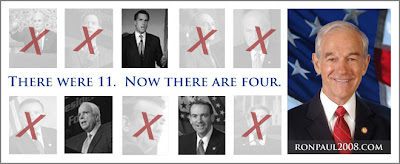 Every movement in history has faced some time of testing, some experience that either forges it into something strong and unified, or forces it to fade away into the history books as another failed experiment.
Dr. Paul has written to you that we are heading straight for Super Tuesday. Our opponents are free to beat up on each other and wear themselves down while we gather our supporters and prepare to storm the convention with delegates.
Last night, over 60,000 people stood up and asked for an end to the runaway violation of our liberties. But contrary to the impression you may be getting from the mainstream media, no national delegates have yet been won in Florida. Those delegates will only be awarded between February 6 and April 30 at delegate selection caucuses, and many of those delegates will be supporters of Dr. Paul.
Ron Paul is the only candidate not to give up on any state in the Republican race, and just as we competed strongly in overlooked states like Nevada and Louisiana, so too will we compete in Maine, Minnesota, and other states that the so-called "top-tier" candidates are content to ignore.
Now, as the focus shifts to Super Tuesday, Rudy's campaign is crushed, Huckabee is losing momentum by the day, and McCain and Romney are fighting over who is the most liberal.
We've been here before. In 1776, despite a courageous effort at holding onto the city, George Washington ceded New York and quickly retreated to New Jersey.
We've been here before. In 1776, despite a courageous effort at holding onto the city, George Washington ceded New York and quickly retreated to New Jersey.
1777 brought the British recapture of Fort Ticonderoga, as well as American defeats at Brandywine and Germantown.
And then, during the winter of 1777-1778, Washington and his army faced perhaps their most humiliating moment, forced to endure a harsh Pennsylvania winter with limited supplies at Valley Forge.
The American revolutionaries dealt with their defeats, focused on their goals, and emerged from Valley Forge as a force that would defeat the most powerful nation on earth.
Our momentum is building. Each one of us, from Dr. Paul himself down to the grassroots supporter who donates the last $5 he or she can give, is focused on the goal.
Early in the struggle for American independence, George Washington wrote: "Perseverance and spirit have done wonders in all ages." Even then, Washington realized that a fierce struggle for self-government can only be won with a spirit of determination equal to the challenge.
Today, in the midst of our new revolution, let's consider Washington's words once again. The task before us is enormous. The foes of liberty are deeply entrenched, and they will not relinquish their power without a struggle.
But fighting in our favor is the unconquerable human spirit, the innate desire to be free. We must embrace this inner strength, dig in our heels, and persevere, just as Washington and his rag-tag colonials, the first American grassroots patriots, did before us. And if we must pass through a Valley Forge or two along the way to victory, let those times of testing temper the steel of our determination.
If Ron Paul is to continue his fight for liberty to the Republican Convention, we need your help in two critical ways:
1. Become a precinct leader today: It's easy, but more importantly, it's vital to Ron Paul's success: https://voters.ronpaul2008.com/.
2. Donate: Just as the Continental Congress supplied General Washington's troops in the field, we too must raise as much money as we can to equip our grassroots supporters.
Help us win this revolution and usher in a new era of freedom, peace, and prosperity. Donate today: https://www.ronpaul2008.com/donate.
Matthew Hawes, Policy Assistant
Daniel McCarthy, Internet Communications Coordinator
Jonathan Bydlak, Fundraising DirectorRon Paul 2008
Bank Reserves Go Negative
By Mike "Mish" Shedlock
I have been watching a chart of Borrowed Bank Reserves for several weeks. The action is unprecedented.
READ THE REST
I have been watching a chart of Borrowed Bank Reserves for several weeks. The action is unprecedented.
READ THE REST
Why Is Bernanke Trying to Fight the Bear?
 Last Tuesday, January 22, 2008, the US central bank lowered its federal funds rate target by a hefty 0.75% to 3.5%. The panicky decision to lower the fed funds rate target was made ahead of the Fed's meeting at the end of this month. Last Tuesday's cut by the Fed was the largest nonscheduled interest-rate cut in more than 20 years.
Let us say that the present aggressive interest rate stance by the Fed fails to prevent the economy from falling into a recession; what kind of action is Bernanke then going to undertake? In some of his writings, he has suggested that, under such circumstances, the Fed should adopt a very aggressive stance and start pushing money on a massive scale, i.e., helicopter money. Needless to say that if this were to happen, Bernanke would run the risk of badly damaging the foundations of the real economy.
FULL ARTICLE
Government Regulation vs Free Markets

Every American, from the top Fortune 500 CEO to the youthful fast-food hamburger flipper, owes his standard of living – the highest in the world – to free market capitalism. It's capitalism – private property and free markets – that provides the information and the incentive that allows each of us to maximize the value of our economic activity. Yet to hear the (mostly) Democratic presidential candidates tell it, free markets are faulty, unfair, and inherently unstable; indeed, government should constantly regulate markets and ride to the rescue whenever recession threatens.
The overall economic ignorance displayed in this year's political campaign has been staggering. Instead of calling for balanced budgets, sound money, permanent tax reductions, and less regulation, most of the candidates have called for more inflation and more government intervention.
READ THE REST
The Sixty-Year Storm
by George Soros
Today’s financial crisis, triggered by the collapse of the housing bubble in the United States, also marks the end of an era of credit expansion based on the dollar as the international reserve currency. It is a much bigger storm than any that has occurred since the end of World War II.
To understand what is happening, we need a new paradigm. It is available in the theory of reflexivity, which I first proposed 20 years ago in my book The Alchemy of Finance . The theory holds that financial markets do not tend towards equilibrium. Biased views and misconceptions among market participants introduce uncertainty and unpredictability not only into market prices, but also into the fundamentals that those prices are supposed to reflect. Left to their own devices, markets are prone to extremes of euphoria and despair.
Indeed, because of their potential instability, financial markets are not left to their own devices; they are in the charge of authorities whose job it is to keep the excesses within bounds. But the authorities are also human and subject to biased views and misconceptions. And the interaction between financial markets and financial authorities is also reflexive.
Boom-bust processes usually revolve around credit, and always involve a bias or misconception – usually a failure to recognize a reflexive, circular connection between the willingness to lend and the value of the collateral. The recent US housing boom is a case in point.
READ THE REST
Today’s financial crisis, triggered by the collapse of the housing bubble in the United States, also marks the end of an era of credit expansion based on the dollar as the international reserve currency. It is a much bigger storm than any that has occurred since the end of World War II.
To understand what is happening, we need a new paradigm. It is available in the theory of reflexivity, which I first proposed 20 years ago in my book The Alchemy of Finance . The theory holds that financial markets do not tend towards equilibrium. Biased views and misconceptions among market participants introduce uncertainty and unpredictability not only into market prices, but also into the fundamentals that those prices are supposed to reflect. Left to their own devices, markets are prone to extremes of euphoria and despair.
Indeed, because of their potential instability, financial markets are not left to their own devices; they are in the charge of authorities whose job it is to keep the excesses within bounds. But the authorities are also human and subject to biased views and misconceptions. And the interaction between financial markets and financial authorities is also reflexive.
Boom-bust processes usually revolve around credit, and always involve a bias or misconception – usually a failure to recognize a reflexive, circular connection between the willingness to lend and the value of the collateral. The recent US housing boom is a case in point.
READ THE REST
The Road to Hyperinflation - Part 2
Central Banking History of Failing to Stabilize Markets
It has been forgotten by many that before 1913, there was no central bank in the United States to bail out troubled commercial and associated financial institutions or to keep inflation in check by trading employment for price stability. Few want inflation but fewer still would trade their jobs for price stability.
For the first 137 years of its history, the US did not have a central bank. The nation then was plagued with recurring business cycles of boom and bust. For the past 94 years that the Federal Reserve, the US central bank, has assumed the role of monetary guardian for the nation, recurring business cycles of boom and bust have continued, often with the accommodating participation of the Fed. Central banking has failed in its fundamental functions of stabilizing financial markets with monetary policy, succeeding neither in preventing inflation nor sustaining growth nor achieving full employment. Since the Fed was founded in 1913, the US inflation has registered 1,923%, meaning prices have gone up 20 times on average despite a sharp rise inproductivity.
For the 18 years (August 11, 1987 to January 31, 2006) of his tenure as chairman of the Fed, Alan Greenspan had repeatedly bought off the collapse of one debt bubble with a bigger debt bubble. During that time, inflation was under 2% in only two years, 1998 and 2002, both times not caused by Fed policy. Paul Volcker, who served as Fed Chairman from August 1979 to August 1987, had to raise both the fed funds rate and the discount to 20% to fight hyperinflation of 18% in 1980 back down to 3.66% in 1987, the year Greenspan took over the Fed just before the October 1987 crash when inflation rose to 4.53%.Under Greenspan’s market accommodating monetary policy, US inflation reached 4.42% in 1988, 5.36% in 1989 and 6.29% in 1990. US inflation rate was moderated to 1.55% by the 1997 Asian financial crisis when Asian exporting economies devalued their currencies to lower their export prices, but Greenspan allowed US inflation rate to rise back to 3.76% by 2000. The fed funds rate hit a low of 1.75% in 2001 when inflation hit 3.76%; it hit 1% when inflation hit 3.52% in 2004; and it hit 2.5% when inflation hit 4.69% in 3005. For those years, US real interest rate was mostly negative after inflation. Factoring in the falling exchange value of the dollar, the Fed was in effect paying US transnational corporate borrowers to invest in non-dollar markets, and paying US financial institution to profit from dollar carry trade, i.e. borrowing dollars at negative rates to speculate in assets denominated in other currencies with high yields.
READ THE REST
It has been forgotten by many that before 1913, there was no central bank in the United States to bail out troubled commercial and associated financial institutions or to keep inflation in check by trading employment for price stability. Few want inflation but fewer still would trade their jobs for price stability.
For the first 137 years of its history, the US did not have a central bank. The nation then was plagued with recurring business cycles of boom and bust. For the past 94 years that the Federal Reserve, the US central bank, has assumed the role of monetary guardian for the nation, recurring business cycles of boom and bust have continued, often with the accommodating participation of the Fed. Central banking has failed in its fundamental functions of stabilizing financial markets with monetary policy, succeeding neither in preventing inflation nor sustaining growth nor achieving full employment. Since the Fed was founded in 1913, the US inflation has registered 1,923%, meaning prices have gone up 20 times on average despite a sharp rise inproductivity.
For the 18 years (August 11, 1987 to January 31, 2006) of his tenure as chairman of the Fed, Alan Greenspan had repeatedly bought off the collapse of one debt bubble with a bigger debt bubble. During that time, inflation was under 2% in only two years, 1998 and 2002, both times not caused by Fed policy. Paul Volcker, who served as Fed Chairman from August 1979 to August 1987, had to raise both the fed funds rate and the discount to 20% to fight hyperinflation of 18% in 1980 back down to 3.66% in 1987, the year Greenspan took over the Fed just before the October 1987 crash when inflation rose to 4.53%.Under Greenspan’s market accommodating monetary policy, US inflation reached 4.42% in 1988, 5.36% in 1989 and 6.29% in 1990. US inflation rate was moderated to 1.55% by the 1997 Asian financial crisis when Asian exporting economies devalued their currencies to lower their export prices, but Greenspan allowed US inflation rate to rise back to 3.76% by 2000. The fed funds rate hit a low of 1.75% in 2001 when inflation hit 3.76%; it hit 1% when inflation hit 3.52% in 2004; and it hit 2.5% when inflation hit 4.69% in 3005. For those years, US real interest rate was mostly negative after inflation. Factoring in the falling exchange value of the dollar, the Fed was in effect paying US transnational corporate borrowers to invest in non-dollar markets, and paying US financial institution to profit from dollar carry trade, i.e. borrowing dollars at negative rates to speculate in assets denominated in other currencies with high yields.
READ THE REST
The Great Depression - The Sequel ?
 The D Bomb Is Dropped
It’s happened. One widely read financial daily very recently dropped the “D” bomb. The article compared today's economic situation not to the 1987 affair with a happy ending, but to the much “darker metaphor” of the Great Depression in 1929.
The main similarity, according to the article was this: The all-out rescue efforts of the financial powers-that-be to stop a downturn and push the economy onto solid ground. Then as now, two main bodies carry out the task: the central bank and the White House.
1929: The Federal Reserve promises “cheaper credit” and slashes the discount rate from 5.5% (1929) to .75% (1932). At the same time, U.S. President Herbert Hoover creates an “Economic Stimulus Plan” to provide $160 million in tax relief to the public.
2008: On January 22, the Federal Reserve approves an emergency 75-basis-point rate cut, the largest single reduction in 23 years (and fourth cut in four months). Days later, U.S. President George Bush encourages Congress to support a $150 billion “Economic Stimulus” through tax rebates.
Merrill downgraded on bond insurers, subprime
BOSTON (MarketWatch) -- Oppenheimer & Co. on Wednesday downgraded shares of Merrill Lynch & Co. to underperform, saying bond insurers' problems could prompt more write-downs at the investment bank and noting the firm's exposure to subprime mortgages.
READ THE REST
READ THE REST
Subscribe to:
Posts (Atom)


